Creating Value In Schools

Please enjoy this free content - for more Need To Know articles please consider a subscription
As well as a promise of £38 billion in investment, key themes of the DfE’s education estates strategy include:
Along with the strategy, the DfE has launched their Manage Your Education Estate service to support schools and trusts in managing their estate.
As this illustration in Chapter 1 of the strategy indicates, the total education estate covers a lot of ground.
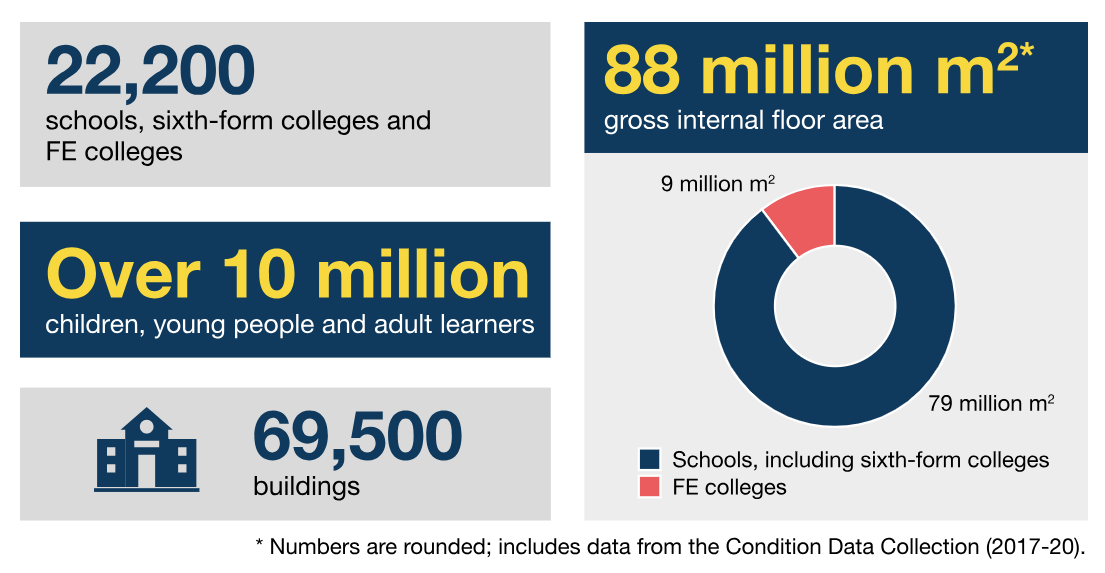
In the executive summary, it’s suggested that ‘historical underinvestment and a lack of long-term funding certainty’ means there are many school buildings which are aging and not fit for purpose.
Furthermore, climate change means that schools are more likely to experience overheating as well as flood risks – hence the focus on risk and resilience in the document.
The strategy acknowledges the impact of pupils’ physical environment on attainment, wellbeing and engagement. Outdoor learning can be linked to improved motivation and even attendance. Furthermore, ‘for some children, school is where they are most likely to spend time with nature, particularly for children with disabilities’ (see chapter 1).
To support good outcomes, we need an education estate that is safe, suitable, sustainable and sufficiently sized.
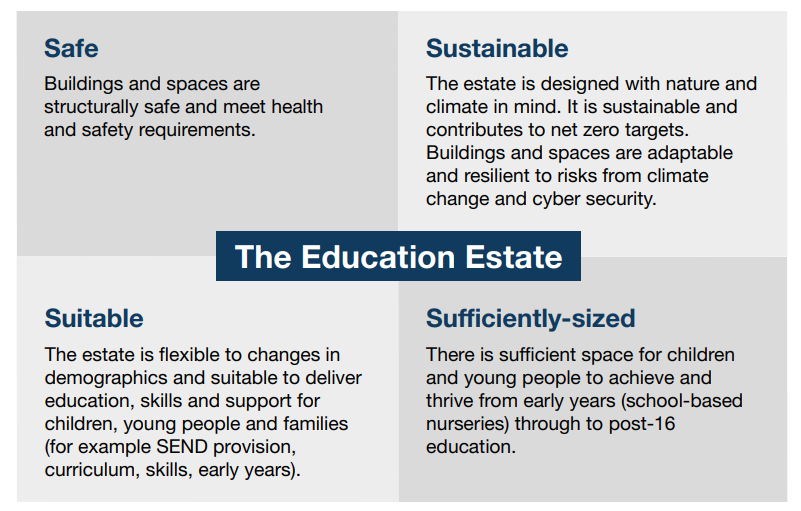
For more detail on how this looks in terms of objective, strategic principles and outcomes, see the table on pages 14-15 of the pdf version.
In this 10 year plan, it’s the government’s intention to:
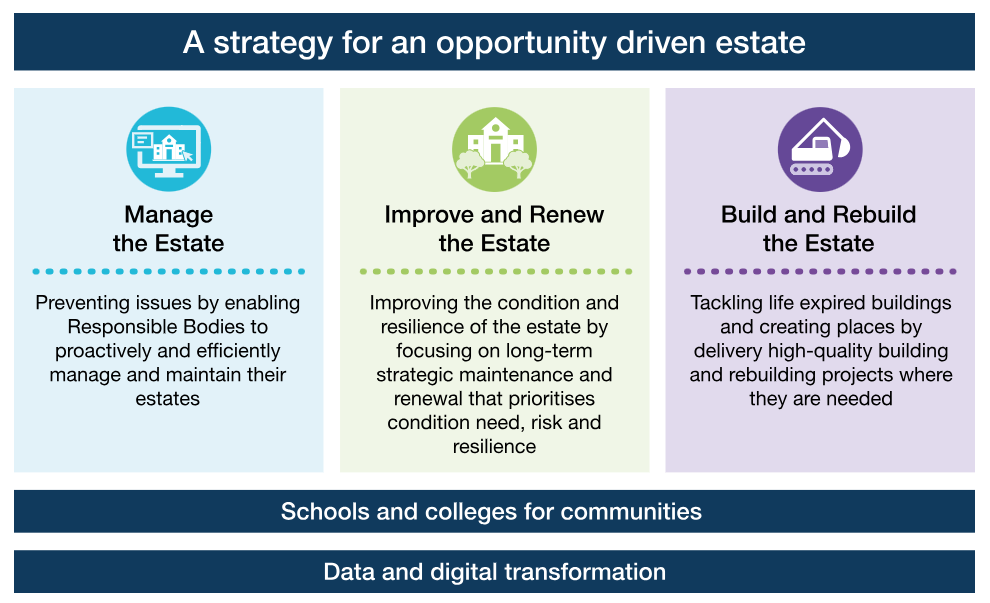
There’s an emphasis in the strategy on ‘responsible bodies’: the 2,800 bodies responsible for the school estate. That could be the local authority, the trust, church trustees, voluntary aided bodies etc.
The estates strategy includes plans for responsible bodies to make an annual return, from autumn 2026, on how they are meeting the expectations in the school estate management standards. There are also plans for more data collection to benchmark performance.
As well as the estate management competency framework and standards, the DfE has put together guidance on developing your long-term estates plan.
The DfE has launched Manage Your Education Estate, a new digital service designed to support responsible bodies to manage their school and college buildings.
You can access the service via the DfE Sign-in.
There’s a thread running throughout the strategy about responding to demographic change and pupil needs, and how schools and trusts can potentially repurpose areas of the estate.
For example, on page 22 of the pdf version of the strategy there’s a case study of a trust that has re-used surplus space for preschool rooms, wraparound care hubs and spaces for local community groups to use – thus strengthening local connections with schools.
Supporting pupils with SEND features highly, with a case study included of a junior school that has repurposed space to create a self-contained annex for specialist support (page 28 of the pdf).