Creating Value In Schools

Paul K. Ainsworth has supported hundreds of schools on their improvement journey in his system leadership roles across four multi-academy trusts. Paul is the author of No Silver Bullets: Day In, Day Out School Improvement and writes on Substack as No Silver Bullets Man.This blog is an extract from our longer conversation, Crisis recovery in schools: ‘it will get better’. It follows on from the blog post Lasagna, honeymoon and slump: phases in crisis recovery. Liz Worthen: Having read Lucy Easthope’s book, Come What May: Life-Changing Lessons for Coping with Crisis, are there situations that you now look back on differently, or where feel you would act differently now? Paul K Ainsworth: I've talked an awful lot about school improvement and not looking for those silver bullets or those quick fixes. Looking back, I think as a headteacher, I probably tried too hard to force improvement. I tried to make things happen too quickly, and wasn't really aware of playing that long game. That's something that I do advise leaders a lot more about now: being prepared to take your time. It will get better. I promise you. I've been around long enough. It will be better. That is hope. You are a good headteacher. You are a good leader. You will get through this. It's going to take us time, and I'll be with you. I'll walk every step with you, but it's going to take time. Don't rush it too far. There’s a really practical piece of advice that one of my friends gave me a while ago, and it’s something that sticks with me. This friend works in communications – he’s a communications director. I was working in a school which was going through a tough time, and I said to my friend, ‘Can we not just put some newspaper stories out? Can we not do stuff? Because actually this school’s got things going on.’ Be aware that your community is not just one cohesive group. His comment? If we put those newspaper stories out too quickly, they'll be linked to the bad news story. So it will be ‘so and so school has won this prize’, or ‘so and so teacher has received this award’. And then underneath, it'll say, ‘this was a school where X happened six weeks ago’. So it’s about taking that time. When I think about some of the difficulties I faced earlier on in my career, I wasn't necessarily aware of that and I was trying to force it too quickly. I think that's part of my role now: trying to encourage people to have patience. Liz Worthen: So, is there other advice that you’ve drawn from the book that you would share with school leaders? Paul K Ainsworth: One of the things that also really stuck with me is being aware that your community is not just one cohesive group. When you go through something difficult, you think that everybody pulls together – and they do to start off with – but actually people are in groups and have different needs. Lucy Easthope talks about that in terms of post-disaster survivors groups or families. Find Lucy Easthope’s book and other inspiring reads in the Creating Value in Schools bookshop. For example, following the Hillsborough disaster, all the parents and families bonded together. But if you look at it now, 30+ years later, there are multiple groups of survivors, because they've all found different things and need different things. I think that's interesting to think through for your community and your staff. I don’t think I did this in the past, when I was a headteacher. I don't think I thought about the needs of my middle leaders being different from my senior leaders, or being different from my ECTs. I just put it all together, as I'm trying to do this for the community. I was talking to a multi-academy trust a couple of weeks ago that was going through an issue and I said to them, but what are the needs we need to look at? They looked at me blankly, and I immediately went back to what Lucy Easthope was talking about. She wrote about people having needs in four groups: tangible needs, intangible needs, impossible needs and hidden needs. I thought that was really interesting. Tangible needs: they're the physical things that we need to do our jobs, or the physical things that children need. Is my interactive whiteboard working in my classroom? Can I deliver my Year 11 maths lesson or my Year 6 maths lesson if my interactive whiteboard isn't working? But actually, if your school’s been flooded, there’s going to be change, isn’t there? What do pupils need? Pupils need teachers in front of them, don't they? They need resources. In some situations it's the basics; they might need food and uniform. We can all think about what the tangible needs are of different groups of people. Intangible needs: they're the things that we need to do as leaders. Where are we going and how are we going to get there? We don’t need to say it all straight away, it might come in chunks, but we’ll tell you how over time. Impossible needs: this might be something like, when something bad's happened, the impossible need is no-one wants to be in that situation. We don't, do we? Or it might be that people don’t want to face more change because something has happened. But actually, if your school’s been flooded, there’s going to be change, isn’t there? And again, as leaders, how do we communicate that? It’s back to the drip feeding of relevant information. I know you don’t want to face change, but we know we have to do this. Hidden needs: what are hidden needs of your children, or your teachers? What are the hidden needs of your senior leaders, and your parents? That can be things like being calm and quiet as a leader. When bad things have happened, people just want calm, quiet. They want to have confidence in you. Children, and a lot of staff, want smiles and they want warmth from you, however you are feeling inside. How do you share that warmth? If I’m working with headteachers, there's two kinds of support that I need to give. It’s a really interesting way of thinking through any kind of difficulty. What are the tangible needs? What are the intangible needs? What are the impossible needs, and what are the hidden needs? And then think about how they might vary for different groups of staff. Liz Worthen: It seems to me that timely information is really important. As you say, you don't need to give everything at once. I was thinking back to COVID and the pandemic, and how people who knew about pandemics knew that probably it would be two years before things were back to semblance of normal. But they didn't say that at the time, when we had the first lockdown. Because that would've just been too much for people to hear, wouldn't it? So instead you talk about what's going to happen in the shorter term, and then we will get to what happens longer term. Paul K Ainsworth: I suppose the other aspect of that is, if for example I’m working with headteachers, there's two kinds of support that I need to give. There's the very technical support. So, say I'm working with a school that's had a fire. The technical support is: how do we fill the insurance forms in, how do we liaise with the fire service? How do we buy things quickly to get things running? If I'm dealing with a school that's had an Ofsted difficulty, the technical support is: how do we improve the school? What are those issues that they've highlighted? What can we do quickly? What's going to take time? Then there's the emotional support for leaders as well. That putting an arm around people, giving people hope for the future, bringing back confidence. But maybe the interesting question is: how are you today? Just one word makes that whole sentence so different. I’ve been reflecting on how those are two different things – technical and emotional support. Sometimes I think we put those together, in terms of here's my technical support, but I'm also with you. I'm giving you emotional support. I think we probably need to just separate them a little bit. More like: in this conversation at the moment, we are doing the technical bit. Then later on in the conversation, and maybe after we have a break, it's: how are you today? How are you feeling? How are you feeling this week? What can I give you emotionally to support you? I sometimes think we put them together in one conversation. That's certainly a learning point for me, and one of the things that I really liked in the book that stuck with me. The thing of not asking, how are you? Because if you're in difficulty, you're never great, are you? But maybe the interesting question is: how are you today? Just one word makes that whole sentence so different, doesn't it? How are you today? No matter how bad it is, please reach out to somebody and get help. Liz Worthen: Because things can change, can't they? Even at different points of the day. You might have felt terrible this morning, but this afternoon, things might seem a little bit better. Paul K Ainsworth: And, I know this conversation's been a little bit dark at times. But I think it's coming from the place of believing that we can get through these things. That’s the perspective I want to give: it doesn't matter how bad it is, it can get better. That's what I'd like readers to take away. And I'd also like people to take away: no matter how bad it is, please reach out to somebody and get help. Whether it’s your family or friends, tell people when it’s not going out well. Reach out to people like me, because this is what we do. We can give you the technical support, we can give you that emotional support. I think I've seen just about everything that possibly can go wrong, and part of the reason I do the job that I do is because I want people to not have to go through that themselves, or to shortcut it. Anything that we can do that rebuilds our reservoirs of hope is so important. Liz Worthen: Thank you for giving us so much to think about, Paul. And I wonder, what's on your reading list next? Or is there anything else you've been listening to or reading recently? Paul K Ainsworth: I'm definitely going to read another one of Lucy Easthope’s books, but I think I need a break before I go to that. So, maybe to get that optimism again, I'd really recommend listening to Lucy Easthope's Desert Island Discs. When I started to listen to that, I wasn't sure if it was a good thing for me to listen to, because I don't like sad things. I like things to be uplifting. But actually, it's a really good listen. It does give you hope. If you want more to read, and this has resonated with you, there's the three blogs where I've tried to summarise what Lucy said, but put it in a school improvement perspective. Hopefully they will give you some hope (there’s that word again!) for the future. Read Paul’s three blogs: Because I think one of the things that I'm really aware of at the moment, is that so many school leaders are in this stage of it feeling like it's one crisis after another. The perma crisis. It just feels like one more domino and another domino and then another domino. But I genuinely believe it will get better. And I think that anything that we can do that rebuilds our reservoirs of hope is so important. That's what I want readers to go away with: you might be having a tough time; other people have had a tough time; it will get better. Please talk to somebody and get support. Liz Worthen: Absolutely. Paul, thank you very much for refilling our reservoirs of hope, as well as insights to take away and put into practice. Listen to the full podcast conversation (35 minutes).
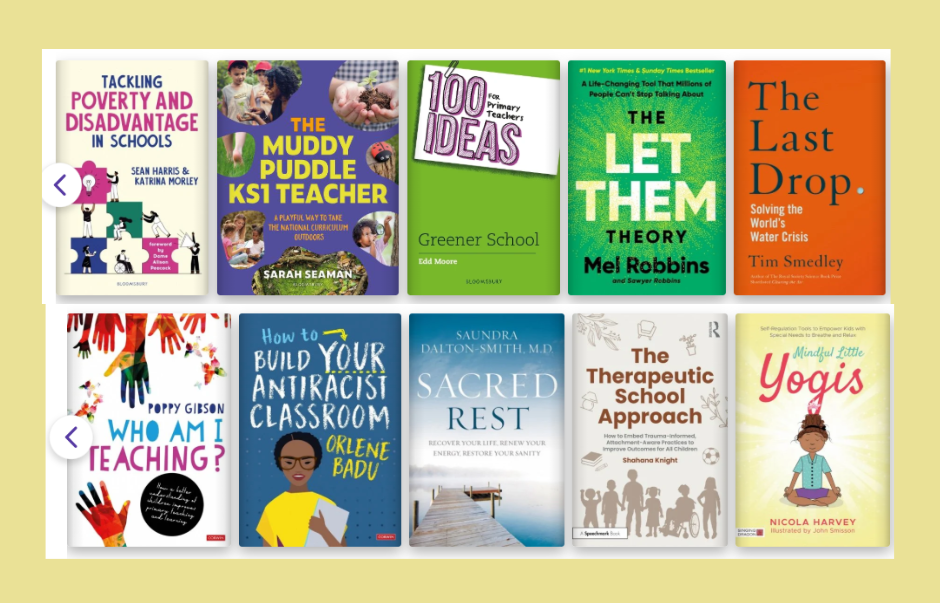
*** If you buy books linked to our site, we may earn a commission from Bookshop.org, whose fees support independent bookshops.Improvement takes time
Consider your community groups
Different types of needs
Timely information with technical and emotional support
Things will get better
Hope amidst the perma crisis
What next?